

Gather Your Supplies
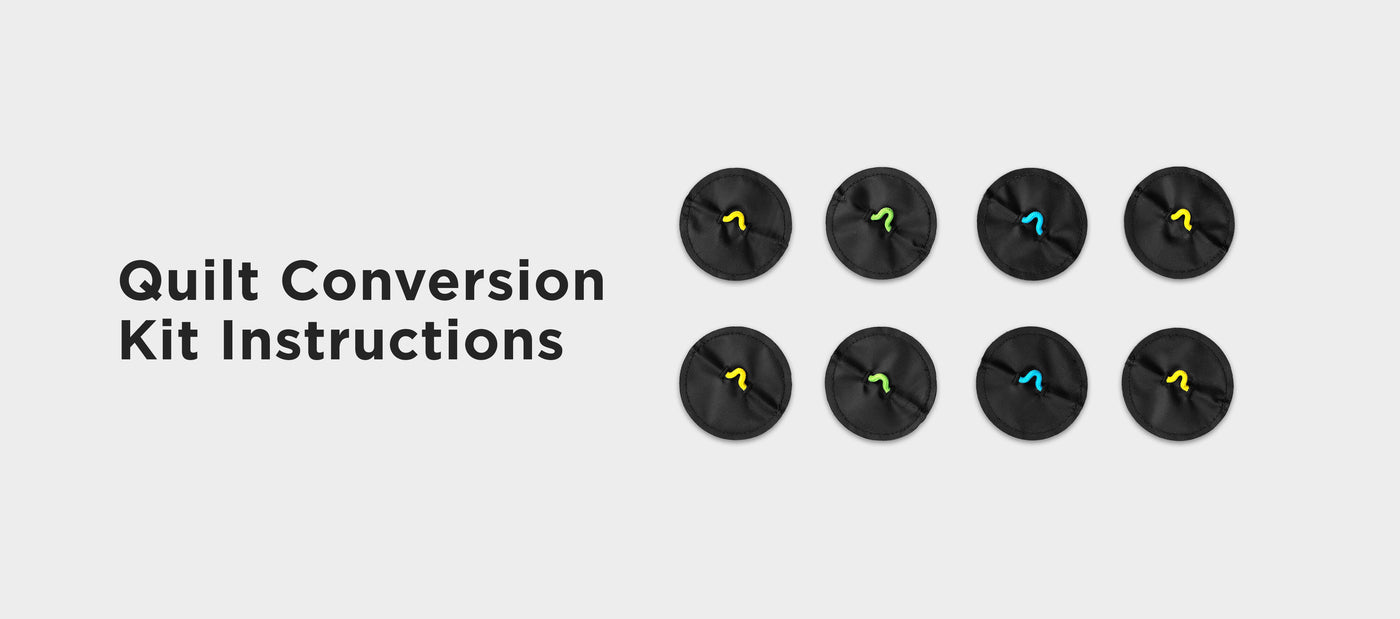
Along with your 8 Zenbivy Conversion Patches, you'll need a measuring tape, scissors, and a non-permanent marking tool such as a fabric marker.
How to Assemble the Printable Template
-

Trim the top of pages 2 through 5 along the grey line. Line up the top of page 2 with the bottom grey line on page 1 and tape.
-

Continue with pages 3, 4, and 5 until all are taped together.
-

Now trim the entire border along the outside edge of the grey line and your template is ready!


Step 2: Mark the Loop Locations
You’ll be installing 4 patches on each side of the quilt (8 total). First, we'll measure and mark where each patch will go. If you are not using the printable template, follow the steps under "With a Measuring Tape"
With the Printable Template
-

1. Lay your quilt out flat on your work surface with the exterior (shell) of the quilt facing up.
-

2. With the Zenbivy logo at the top, align the outer edge of the template to the edge of your quilt and align the top edge of the template so it is square with the top of your quilt.
-

3. On the side closest to the center of your quilt, place a mark at each of the 4 dotted lines/arrows. Slide the template over to the other side of your quilt and repeat.


With a Measuring Tape
-

1. Lay your quilt out flat with exterior (shell) facing up. From the top corner of the quilt, measure 25 cm along the top of the quilt in towards the center. Mark that point as your vertical reference line.
-

2. From that first mark, measure 34 cm straight down. This is where the first loop patch will be placed. Mark this spot.
-

3. From the center of your first marked location, measure 22 cm straight down to find the next loop position. Continue until you end up with 4 marks total. Then repeat on the other side of your quilt.
-

PRO TIP: Double-check side-to-side placement as you go. Each loop patch should always be 25 cm in from the quilt’s edge.


Step 3: Apply the Patches
Once marked, it's time to stick the patches on! It's helpful to have another set of hands for this step.
Zenbivy uses a color-coded pattern to help match loops on the quilt with clips on the sheet. From the top down it's Yellow, Green, Blue, Yellow on both sides.
-

1. Remove the paper backing from the patch to expose the adhesive.
Having trouble peeling the backing? Look for the split near the center and start there.
-

2. Stretch the quilt’s shell fabric flat to create the smoothest surface possible. Applying patches over seams is alright when necessary.
-

PRO TIP: An embroidery hoop is a great installation tool that can help stretch the shell fabric flat and give your patch install a professional look.
-

3. Position the patch over the marked spot, ensuring the loop cord runs vertically (parallel to the side of the quilt). Align the center of the raised loop with the marked measurement.
-

4. Apply the patch with firm pressure, and continue to press around the outer edge to ensure the patch fully adheres to the quilt fabric. See note below under "Why Press Firmly?"
-

5. The patches will have a 72 hour cure time. We recommend placing the patches and waiting the full cure time before using them in the field.


Why Press Firmly?
Because the backing is a pressure-sensitive adhesive (PSA), applying firm, even pressure is essential to create a strong, lasting bond.
Ensure the entire perimeter of each patch is firmly pressed down, with no lifted edges. The low-profile, snag-free design relies on full edge adhesion to ensure longevity. Any lifted edge could catch on fabric or gear, which could lead to snagging and separation.

Done!
After 72 hours, your Conversion Patches are fully cured and ready to be used with your Zenbivy sheet. Get ready for a comfortable, draft-free night of sleep.